A town built on slate
In 1853, Joseph Kellow found slate in what is now Pen Argyl. By the following spring, the first local quarry was open. Workers and their families settled near the quarries. When the railroad arrived in the 1880s, the town grew around the industry that gave Pennsylvania’s Slate Belt its name. [1] [2] [3]
How Pen Argyl got its name
Before it was called Pen Argyl, the community was known as Slateville or Wind Gap Quarries. Some quarry families favored Delabole, the name of the town they had left in England. A local account credits Bethlehem merchant Augustus Wolle and his brother Sylvester with suggesting Pen Argyl in 1865. [7] [8]
According to that account, Augustus paired the Welsh word pen, meaning “head,” with argylite, a word he associated with slate. The account gives the meaning as “head or mountain of slate rock.” Pen Argyl was incorporated as a borough on June 12, 1882. [7] [9]
The twin schoolhouses on Pennsylvania Avenue
By 1892, more than 600 pupils crowded Lincoln School. Pen Argyl built Garfield School that year and named it for President James A. Garfield. When the town needed another school in 1907, it built McKinley School and named it for President William McKinley. The two buildings on Pennsylvania Avenue each stand three stories high, with matching red-brick façades. Both were later converted into apartments. [1]
From Cornwall to the quarry lunch pail
Families from Cornwall, England, brought the pasty to the Slate Belt. Quarry workers carried these savory meat pies to work in a metal lunch pail called a blickey. The tradition reached well beyond the quarries. In Pen Argyl, Wednesday was pastie day, and DeNardo’s on Pennsylvania Avenue served them as its Wednesday special. [4]
How Weona Park got its name
In 1920, the Pen Argyl Park and Athletic Association bought land for an athletic field. According to local history notes, the land belonged to the Lobb family. Neighbors of all ages helped prepare the grounds. [2] [10] [11]
After the park opened in 1921, the association invited residents to name it. Local history notes place the opening in May and describe how fourteen-year-old Corienne Broad’s suggestion was chosen from hundreds of entries. Her winning name, Weona Park, was a play on the words “We own a park.” [2] [11]
The carousel at Weona Park
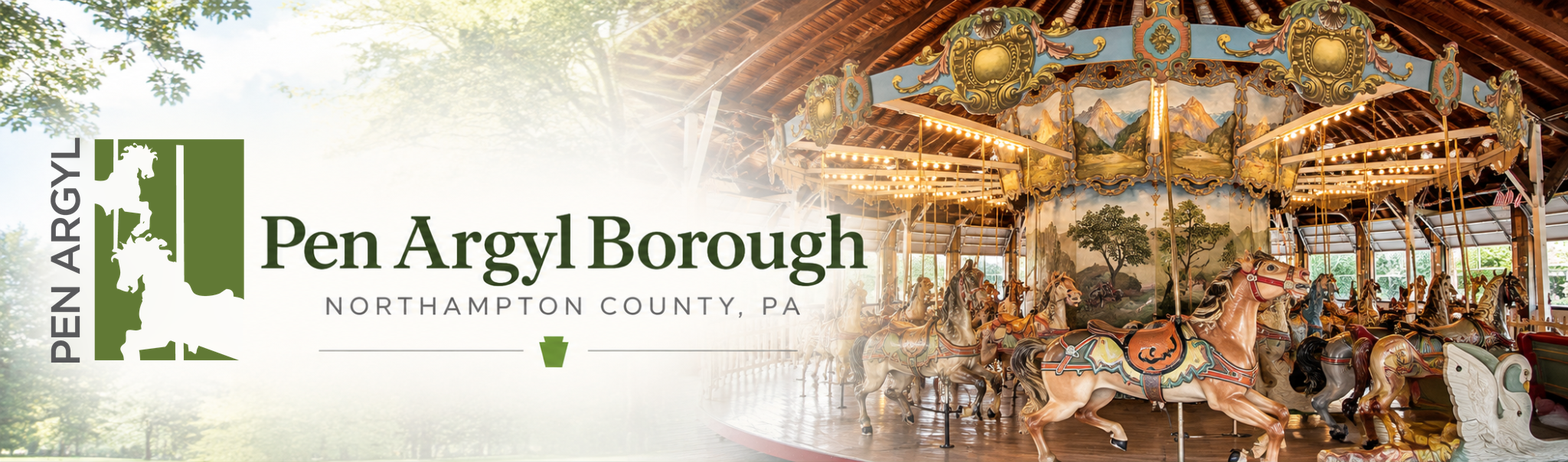
In 1923, the Borough brought a carousel from Philadelphia’s Dentzel company to Weona Park. Thomas credits carousel maker William Dentzel. Beneath its slate roof are 44 carved wooden animals that stay at a fixed height as the carousel turns. Look closely and you can tell the horses apart. Sharing the carousel with the horses are goats, giraffes, deer with real antlers, and a single zebra. [1] [2] [5]
Thomas described the Weona Park carousel as one of only two surviving Dentzel examples with original paint when he wrote his account. [1]
In the 1990s, residents helped care for the carousel through the Friends of the Carousel’s “Adopt an Animal” program. Sponsors could name an animal, and their contributions helped pay to repaint the figures. The carousel was listed on the National Register of Historic Places in 1999. [2] [6]
Sources
[1] George E. Thomas, “Pen Argyl,” Pennsylvania, SAH Archipedia, edited by Gabrielle Esperdy and Karen Kingsley. Charlottesville, University of Virginia Press, 2012–. Read the SAH Archipedia essay.
[2] Pen Argyl Borough, Weona Park Master Site Development Plan (2018). Read the Borough’s park history (PDF).
[3] “The Slate Industry in Pennsylvania.” Read the account of Pen Argyl’s early quarries and name (PDF).
[4] Larry Cory, “Mr. Pastie Celebrates Grand Reopening.” Read the local account of the Cornish pasty (PDF).
[5] National Carousel Association, Census of Classic Wood Carousels, Weona Park entry. View the carousel census.
[6] National Park Service, “Weona Park Carousel,” National Register of Historic Places, record 99000879. View the National Register record.
[7] “The True Story of The Naming of Pen Argyl.” Local history clipping. Author, publication, and date are not shown in the excerpt.
[8] Northampton County, “Pen Argyl Borough,” Our Communities. Read the county’s account of the borough’s early names and Augustus Wolle.
[9] Local Geohistory Project, “Pen Argyl Borough 1882 Creation.” View the date of the incorporation decree and its court-record references.
[10] Michael Ortoski, “Pen Argyl Borough Prepares To Celebrate Weona Park 100th Anniversary,” Blue Valley Times, April 30, 2019, p. 2. Read the centennial account of residents building the park (PDF).
[11] Local history notes on the founding and naming of Weona Park, supplied for this history. The notes identify the Lobb family, the May opening, Corienne Broad’s age, and the size of the contest.
